
 By Madsen Lake
The modern white-collar workspace demands hours of mental focus, often at the expense of physical health. Millions of professionals spend the vast majority of their waking hours anchored to an office chair, staring intently at digital displays. While this sedentary configuration maximizes processing efficiency and workflow output, it places a severe toll on the human musculoskeletal system. Prolonged sitting causes core stabilizer muscles to go dormant, tightens the hip flexors, deconditions the gluteal muscle groups, and forces the cervical spine into a forward posture that creates baseline tension.
The Science of Activity Snacks: Why Micro-Movements Matter
To understand the value of office exercise, you must move past the idea that fitness only happens during sixty-minute workout sessions. Exercise physiology increasingly highlights the profound impact of activity snacks, which are short, brief intervals of physical movement distributed throughout the day.
When you sit continuously for hours, your skeletal muscles stop contracting, causing a dramatic down-regulation of lipoprotein lipase. This essential enzyme is responsible for clearing lipids and triglycerides from your bloodstream and converting them into energy. A lack of muscle contraction causes your metabolism to stall, leading to elevated blood glucose levels and increased insulin resistance.
Engaging in brief physical activity for even three to five minutes every hour reboots this biological system. The simple mechanical act of contracting your muscles triggers glucose transporter proteins to move to the cell walls, allowing your body to process circulating sugars for fuel, independent of insulin production. Furthermore, these regular bursts of movement stimulate the lymphatic system, which lacks a central pump and relies entirely on muscular contraction to flush metabolic waste products out of your tissues.
Routine 1: The Core and Postural Alignment Sequence
Long hours of keyboard typing inevitably lead to a slumped posture, characterized by rounded shoulders, a collapsed thoracic spine, and a forward head position. This routine focuses heavily on opening up the anterior chest walls while activating the neglected postural stabilizers in the upper back. Perform these movements smoothly without jerky transitions.
-
Seated Shoulder Blades Squeezes: Sit up straight away from the backrest of your chair. Place your feet flat on the floor, keep your arms at your sides bent at ninety degrees, and consciously pull your shoulder blades back and down as if trying to pinch a pen between them. Hold the contraction for five seconds, then release. Complete fifteen controlled repetitions.
-
Desk Angels: Sit upright and extend your arms out to the sides, bending your elbows at ninety degrees to form a W shape with your upper body. Slowly raise your hands toward the ceiling, straightening your arms fully while keeping your shoulders pulled down away from your ears. Lower back down to the starting position under control. Perform twelve repetitions.
-
Seated Torso Twists: Place your right hand on the outside of your left knee. Gently rotate your torso to the left, using the leverage of your leg to deepen the stretch through your thoracic spine. Hold the end range for three deep belly breaths, then slowly reverse the direction to target the opposite side. Complete five twists per direction.
This routine immediately reduces mechanical strain on the lower neck and upper traps, preventing the development of tension headaches.
Routine 2: The Lower-Body Circulatory Boost
Your legs contain the largest muscle groups in your body. When left inactive, blood and fluid pool in the lower extremities, causing sluggish circulation and feelings of heavy, fatigued legs. This quick routine uses the weight of your body against gravity to reactivate the lower body pump.
-
Chair Squats: Move your office chair slightly away from the desk. Stand with your feet hip-width apart, extend your arms forward for balance, and lower your hips down until your glutes lightly brush the seat of the chair. Immediately drive through your heels to return to a full standing position, squeezing your glutes at the top. Perform twenty continuous repetitions.
-
Seated Leg Extensions: Sit toward the front edge of your chair. Hold the sides of the seat structure for stability. Extend your right leg straight out in front of you, flexing your quadriceps muscle strongly at the peak of the movement. Hold for two seconds, lower it back down to the floor, and repeat on the left leg. Complete fifteen repetitions per side.
-
Desk Calf Raises: Stand up and place your hands lightly on the back of your chair or the edge of your desk for balance. Raise your body up onto the balls of your feet, lifting your heels as high as possible. Hold the top contraction for one second to pump blood out of the lower legs, then lower under control. Complete twenty-five repetitions.
This sequence increases lower body oxygenation, which rapidly clears away the physical lethargy that accumulates after long team calls.
Routine 3: The Upper-Body Isometric Strength Builder
You do not need heavy dumbbells or resistance bands to maintain muscular tone and joint integrity. Isometric exercises involve contracting a muscle against an immovable force, allowing you to generate high levels of muscular tension safely and discreetly at your desk.
-
Desk Press-Downs: Sit upright with your forearms resting flat on the surface of your desk, palms facing downward. Flex your abdominal muscles, and forcefully press your palms and forearms down into the desk as hard as possible for ten continuous seconds. Relax for five seconds, and repeat this cycle five times. This targets the triceps, core, and lats.
-
Under-Desk Bicep Pulls: Place your hands palms-up against the underside of your desk structure. Keep your elbows tucked in close to your ribs. Attempt to pull your hands upward as if trying to lift the desk off the ground, engaging your biceps and forearms at maximum effort for ten seconds. Repeat five times.
-
Seated Isometric Chest Press: Bring your palms together in front of your chest in a prayer position. Forcefully push your hands against one another, engaging your pectoral and anterior shoulder muscles. Maintain the maximum compression for twelve seconds while breathing normally, then release. Repeat four times.
Isometric exercises provide an exceptional stimulus for maintaining muscle fiber recruitment without causing sweating or clothing damage.
Routine 4: The Hip Flexor and Mobility Restoration Protocol
Sitting locks your hips into a constant state of ninety-degree flexion. This shortens the psoas and iliacus muscles over time, pulling the pelvis into an anterior tilt that places destructive shear force on the lumbar spine. This mobility protocol systematically opens the lower kinetic chain.
-
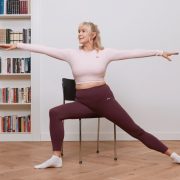
Desk Assisted Lunges: Stand facing away from your desk. Step your left foot forward and slide your right foot back, resting your hands on your desk or chair for structural balance. Lower your hips down into a shallow lunge until you feel a profound stretch along the front of your right hip. Hold for twenty seconds, then switch sides.
-
Seated Figure Four Stretch: While sitting in your chair, lift your right ankle and rest it across your left knee, creating a shape that resembles the number four. Keep your spine completely straight and gently hinge forward from the hips until you feel a deep stretch in your right glute and piriformis. Hold for thirty seconds, then repeat on the opposite leg.
-
Desk Hamstring Hinge: Stand up and place your right heel on a low footrest or the base structure of your desk, keeping the leg straight. Keep your hands on your hips, lock your spine in a neutral position, and hinge backward at the hips to feel a clean stretch down the back of your thigh. Hold for twenty seconds per leg.
Integrating this mobility protocol twice a day completely relieves the tight, locked-up sensation in the lower back that develops by late afternoon.
Routine 5: The Desktop Cardiovascular Micro-Burst
If you find your cognitive focus dropping during a complex project, you likely need a temporary boost in cerebral blood flow. This routine is designed to elevate your heart rate briefly, forcing fresh oxygen to the brain to enhance executive function.
-
Desk Mountain Climbers: Place your palms firmly on the edge of a sturdy, non-rolling desk, stepping your feet back until your body forms a straight plank line at an angle. Quickly drive your right knee toward your chest, then step it back while simultaneously driving your left knee forward. Maintain a rapid, rhythmic pace for forty-five seconds.
-
Shadow Boxing Intervals: Stand up away from your workstation. Drop into a loose athletic stance, soften your knees, and throw controlled, alternating shadow boxing punches into the air in front of you. Focus on rotating your torso and engaging your core with each extension. Continue at a high-energy pace for one minute.
-
Desk Edge Incline Push-Ups: Grip the edge of your desk slightly wider than shoulder-width apart in a plank position. Lower your chest down toward the desk surface by bending your elbows, keeping your core completely rigid. Push back up to the starting position. Perform fifteen rapid, controlled repetitions.
This sudden metabolic shift clears away cognitive fatigue far more effectively than a third cup of caffeinated coffee.
Frequently Asked Questions
Will doing these desk exercises make me sweat and ruin my professional clothing?
No, these routines are engineered to improve circulation, joint mobility, and muscular activation without driving you into an intense anaerobic state. By keeping the durations short, focusing on controlled breathing, and utilizing isometric tension rather than sustained high-intensity cardio, you can stimulate your metabolism without elevating your core body temperature to the point of producing sweat.
How can I perform these movements discreetly without distracting my coworkers?
The isometric routines, seated leg extensions, and shoulder blade squeezes can be performed completely invisibly while you are actively reading a report, typing an email, or listening to a webinar. For the standing movements, you can use a private office space, step into a quiet conference room between meetings, or encourage your immediate team members to join you, transforming the movement break into a healthy shared cultural habit.
What should I do if my office chair has wheels and rolls away during exercises?
Safety must remain your primary priority. If your office chair is equipped with casters, push it firmly against a wall or a stable filing cabinet before attempting movements like the figure four stretch or seated leg extensions. For any routine that requires pushing against an object, such as incline push-ups, bypass the rolling chair entirely and utilize the edge of a heavy, solid desk or a structural wall.
How frequently should I integrate these fitness routines into a standard eight-hour workday?
The optimal cadence is performing one quick three-to-five-minute routine every sixty to ninety minutes. You do not need to execute all five routines at once. Instead, rotate through them sequentially across the day. For example, use the postural routine mid-morning, the circulatory boost right before lunch, and the mobility protocol during the late afternoon slump to keep your body structurally balanced.
Can these desk exercises completely replace my regular workouts at the gym?
These routines are designed to function as countermeasures against the structural damage of prolonged sitting, rather than a total replacement for comprehensive strength training or cardiorespiratory conditioning. They maintain your metabolic baseline and preserve joint health during work hours, making them an excellent supplement to a broader fitness lifestyle executed outside the office.
Are these movements safe to perform if I am already managing a diagnosed bulging disc?
If you have an active spinal pathology, you must exercise caution and consult your physical therapist before starting any new regimen. Avoid the seated torso twists completely, as twisting under axial compression can aggravate spinal discs. Focus instead on the standing calf raises, isometric desk press-downs, and gentle shoulder blade squeezes, which prioritize a neutral, unsupported spine.