 By Madsen Lake
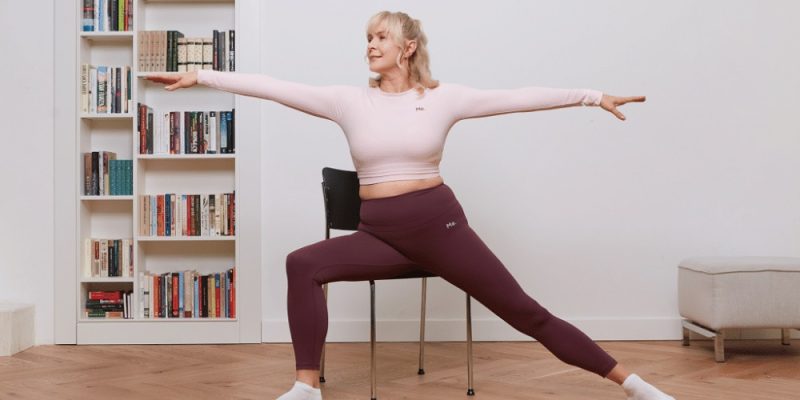
Using a chair during yoga does not mean that a participant lacks mobility or fitness. External support can reduce balance demands, clarify weight distribution and allow greater attention to movement quality. In chair yoga, mobile adults can use the chair as a training tool rather than treating it only as an accessibility aid.
Support becomes especially valuable when a participant wants to slow a transition, isolate a movement or practise on a day when fatigue makes unsupported positions less reliable.
Support Does Not Remove All Physical Demand
A chair changes the task, but it does not automatically make every exercise easy. A participant can use light hand contact while the legs and trunk still perform substantial work.
The amount of support can be adjusted. Holding the chair firmly provides more stability, while resting one or two fingers on it supplies a smaller reference point. The participant may also hover the hand above the chair and touch down only when balance changes.
This makes the chair a scalable tool. It allows the exercise to remain challenging without turning every repetition into a pass-or-fail balance test.
Better Balance Can Improve Strength Practice
When balance is the limiting factor, the target muscles may not receive a useful training stimulus. A participant performing a standing hip movement may stop because of wobbling before the hip muscles become meaningfully challenged.
Using a chair can reduce the balance demand enough to focus on leg control. The participant may then perform the movement more slowly, use a suitable range and notice left-to-right differences.
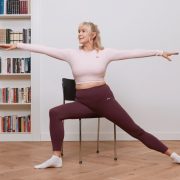
This principle also applies to lunges and supported squats. The hands provide stability while the legs manage load.
Removing all support is not always the most advanced option. A supported exercise performed with greater control can be more demanding than an unsupported version completed through momentum.
A Chair Clarifies Weight Distribution
Participants may not notice that most of their weight has shifted towards one foot. Light contact with a chair can make it easier to reorganise stance without fear of losing balance.
The instructor may ask the participant to compare pressure through the heels, forefeet and sides of the feet. The goal is not necessarily perfectly equal loading, but awareness of the chosen distribution.
During a supported lunge, the participant can adjust stance length while maintaining control. In an unsupported class, concern about balance may prevent this exploration.
The chair creates time to make an intentional decision.
Seated Does Not Mean Passive
Seated movements can challenge trunk and hip control when they are designed deliberately. The chair reduces the need to manage standing balance, allowing the exercise to focus elsewhere.
A seated leg lift may reveal whether the participant leans backwards or rotates the pelvis. A controlled twist can examine upper-back movement without adding a standing demand.
The seat height affects difficulty. A low chair generally requires greater hip and knee movement when standing up, while a higher surface reduces the range.
Participants should use a stable chair without wheels and place it on a non-slip surface.
Support Helps Slow Transitions
Moving between the floor and standing can consume time and energy that might be better directed towards the main objective. A chair can create an intermediate level.
The participant may practise:
- Standing up with controlled foot pressure.
- Lowering without dropping onto the seat.
- Moving from sitting into a supported lunge.
- Turning while maintaining light hand contact.
- Changing stance without rushing.
- Returning upright after a fold.
These transitions are relevant to everyday movement as well as yoga practice.
A slower transition often reveals more than the final pose because momentum is reduced.
Chair Use Can Reflect Daily Readiness
Training capacity changes according to sleep, work stress, recent exercise and travel. A participant who normally practises without support may benefit from a chair on a lower-capacity day.
Using support can preserve session quality instead of forcing the usual variation. It also reduces the assumption that exercise must progress in one direction from supported to unsupported.
The participant may use the chair for one pose and not another. Support should match the task rather than become a fixed identity.
Avoid Leaning Heavily Without Intention
A chair can assist control, but it can also become a place to transfer all effort. The instructor should clarify how much hand pressure is intended.
One useful method is to begin with firm support, establish the position and gradually lighten the grip. If alignment or breathing changes immediately, the higher support level may still be appropriate.
The chair should not slide or tip. Participants should avoid pulling strongly on lightweight furniture or using unstable folding chairs.
Equipment safety is part of exercise selection.
Measure Progress Through Control
Progress does not need to mean discarding the chair. Useful improvements include:
- Using lighter hand contact.
- Performing a slower lowering phase.
- Increasing controlled range.
- Breathing more consistently.
- Completing similar work on both sides.
- Recovering balance with less urgency.
- Selecting support independently.
These changes demonstrate improved capacity even when the equipment remains present.
A chair can also allow progression through increased duration or more precise movement rather than reduced support.
Use the Chair as Deliberate Equipment
At Yoga Edition, participants can explore chair-supported classes without assuming that the format is defined by age or limited mobility. The instructor can adjust hand contact, range and tempo according to the individual task.
For mobile adults, chair yoga offers an opportunity to train control without allowing balance to dominate every exercise. It can fit into office routines, recovery days or a broader studio programme.
External support is valuable when it helps the participant perform the intended movement more clearly. The goal is not to prove that the chair is unnecessary. It is to use the chair well enough that movement becomes more controlled, adaptable and purposeful.